It’s [Not] Complicated…

Complicated and Confused

The biggest issue I hear when I tell people I’m a Christian is “Isn’t it terribly complicated? I mean, there’s all those things you can’t do.”

The hardest thing about my Faith in my experience is explaining how simple it actually is. Most people seem to think Christianity is either irrelevant – which is ok because they have a clear idea of what they’re rejecting – or similar to the Gordian Knot in it’s complexity.

In point of fact, Christianity is a very simple system. It goes something like this:

  • God is a just God.
  • He gave Adam one “don’t” instruction and told him the consequences of breaking it.
  • Adam broke it.
  • Rather than wipe out all His creation and start over, God chose to take His own punishment on behalf of Adam’s descendants.
  • He gives us the choice to accept His gift or reject it.
  • Acceptance makes us right with Him for eternity
  • Rejection means we face His judgement.

The issue most people today have is trying to deal with the thought that a Loving God will send people to Hell.

Mostly this is avoided by simply not believing in Hell. It makes it easy because people stop seeing consequences to their actions. The death penalty is no longer an effective deterrent to criminals in part because they have no concept of what lies beyond. Consider how in the USA the number of mass shootings end with suicide by the gunman. There’s no fear of an eternal consequence for their actions.
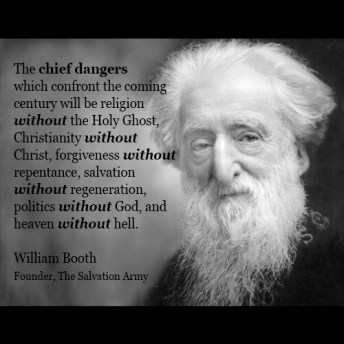
3909d-william2bbooth

William Booth spoke of the

consequences we face today at the turn of the 19th Century.

He was largely dismissed at the time as people couldn’t imagine a world where his predictions could happen.

Within 2 decades the First World War broke out and Western society changed forever. Just 21 years later in 1939 the Second World War took out the second consecutive generation of young men on a global scale and the change was effectively complete. By the late 1950s and early 60s the concept of Hell was all but dropped by most preachers. Many wouldn’t touch it because of the experiences so many had had during the War, either by bombings or on the battlefields of Europe and the Far East. Korea and Vietnam didn’t help, and the concept of “Hell on Earth” became popular and having been through it, Heaven would surely be the reward for everyone.

Now Christianity is straightforward, but not that simple.

Christianity is such a straightforward offer that it requires special talent to misunderstand it. Unfortunately, there is much of this talent available.

God is not the author of confusion (1 Corinthians 14:33). He is undoubtedly a God of order. You can’t look at the way the planets rotate or how perfectly a honey-bee is able to draw the nectar from a flower and truly doubt the perfection of His design. Such design can only be achieved through order.

Yet somehow Christianity has been relegated to a “get out of Hell free” card in some transcendental monopoly game. So often there is little, if any, sign of Power in Faith. I’m not talking about political power, but real life changing power as the Disciples showed.

Over the last 2000 years there have been times of growth and times of stagnation in the Christian Faith. Every time of growth has corresponded with a return by a significant group to the simple, basic Truths of the Faith that have been central since Jesus’s time.

Capitec, a small bank in South Africa, advertises with the tag-line “Simplicity is the Ultimate Sophistication.” It’s true. The theory is sound. The simpler things are, the better they work.

Compare the simplicity of Christianity with the legalism of Islam. Eat anything because it’s what comes out of our mouth that shows us to be clean or unclean. Pray without ceasing, facing any direction you want and don’t worry if you didn’t bathe first – just talk to Me. Don’t rely on your own efforts to be “good enough” to get to Heaven, just rely on Jesus to be good enough and let Him bring you in.

I have several friends who are Muslim. We don’t often discuss religion as with some it has caused offence in the past. These days I lean more to living Christianity around them and let them ask why I’m doing what I do. It’s difficult, but I’ve always struggled with the people I’m closest to in terms of “evangelising”. I’m not a natural evangelist. On the few occasions we have spoken the differences between our faiths is stark. During Ramadan I spoke to one friend about fasting. She asked how fasting differed for Christians from the Muslim fast. I explained that when I fast I fast for a few days at a time. During that time I will eat nothing and drink only water and tea. She asked me what time each day I stopped. I explained that I didn’t. Fasting is total abstinence from food 24 hours a day while I fast.

She nearly fell off her chair. Not being able to eat at sundown was beyond her comprehension. She asked how long I have to fast for, what the “requirements” were. Again, it was obvious that my response was a surprise. I know people who have fasted for three weeks or more in that way, and some who fast just a day or two.

The freedom from a legalistic requirement on how and when to fast or pray is integral to the concept of Relationship in Christianity. If Alexander Graham Bell had been around in First Century Jerusalem, I’m 100% certain Jesus would have likened prayer to a personal call to God from His children – and He was just waiting for it to ring. The Bible was the call to us, kind of like an answerphone message, begging us to call Him back.

My mum tends to phone me around 8:30pm most nights. If I can’t answer for some reason she leaves a message and if its not too late I call her back. But I can call her or vice-versa at any time during the day. Imagine if I could only call or receive a call at a specific time from a phone plugged in to a particular socket. That wouldn’t be relationship, it would be ritual.

Jesus is all about relationship. His purpose was to restore Relationship with the Father by His sacrifice. The breaking of the legalistic requirements of the Law by completing it was the method. The point of the Law was to show mankind that we could not make it to God ourselves, but rather to point to Him as the one we needed to receive salvation. Any religion that then takes us back to following a set of rules instead of the freedom of Grace confuses and complicates our existence.

There are rituals in Christianity. The most obvious is Communion, but while it is important, the point is not transubstantiation of the sacraments, but rather the symbolic being part of Jesus and Him being part of us. The ritual isn’t supposed to replace the relationship, but remind us of the reason – Relationship.

Simple, clear and plain.

It’s really not that complicated.

The Folly of Legalism

What to do when everything is Forbidden

“Thou shalt not…

So says much of the opinion from the Pharisees. It’s echoed in the doctrines of Catholicism, Anglicanism, Lutherism. Calvinists swear by it. Southern Baptists in particular have a long list.

The Law in the Old Covenant was misunderstood in a huge way. The ancient Jews thought it had been given to them so they could earn a way to Heaven. They completely missed the point.

A couple of years ago I read a great book called “The Year of Living Biblically” by AJ Jacobs. He describes it as “One Man’s Humble Quest to Follow the Bible as Literally as Possible”. It’s a brilliant and funny look at the crazy Laws of both the Old and New Testaments. A satirical (I hope!) look at legalism.

The thing is, as amusing – and trust me, it’s amusing – as it is, Jacobs focusses on the things forbidden by the Bible. I think to make a point.

And it did. It got me thinking about what I believe, and why I believe it.

The point of the Law was to demonstrate to the Jews that Salvation in every area was impossible to achieve by following a set of rules. Jesus equates holding anger in your heart to murder and “appreciating” the figure of the girl across the street as adultery. Just in those two simple thoughts at some point we’ve all been guilty of murder, coveting, adultery, etc, etc…

And I do mean all been guilty of it.

Pretty much the only thing that got a jail sentence under ancient Law was debt. Everything else, they killed you. That’s why when Jesus is brought the woman caught in the act of adultery nobody throws a stone. In retrospect, every one of them realised they were as deserving of stoning as the woman was.

I heard Donald Trump say he’d never asked forgiveness from God because he’d never done anything that needed forgiving. Maybe in terms of outward actions he’s right – unless you count adultery anyway. But he’s demonstrated what his thoughts are countless times, and I think we can agree this is a man who lacks a moral compass.

Not that Hilary Clinton is any better. She just knows how and when to keep her mouth shut (mostly). Politics is rife globally with morally bankrupt pseudo-leaders claiming innocence. In South Africa, Jacob Zuma was tried for rape shortly before being elected President, and the Constitutional Court held that several hundred counts of corruption and failing to uphold the Constitution should be prosecuted against him.

It seems like anything goes these days.

Nothing it forbidden any more.

St Paul had a similar problem in the church in Rome. Much of the society there can be seen in modern attitudes. Things which were absolute negatives by Mosaic Law were so commonplace nobody noticed them as sin any more. They were just a part of the way things were. Temples had prostitutes in them – some had more than the brothels did – murder was put on daily as entertainment in the Coliseum and Circus Maximus in Rome and the amphitheatres around the Roman Empire.

What do you do when society demonstrates no moderation?World Law

Demonstrate Holiness.

Worldly society is gradually changing the rules for mankind. When warned of changes, Christians need to be the ones to initiate reforms. Throughout history for 2000 years that’s what has happened. Abolition of slavery, education for all, welfare handouts (alms), legal age of consent, age of majority, ending racism and sexism (or trying to). These have been done, and are being worked on by Christians. Men like William Wilberforce, John and Charles Wesley, William Booth, Billy Graham, CH Spurgeon and many other lesser known but equally important men and women of God have changed history.

But their focus was mainly on what was not forbidden rather than a list of decrees on stopping behaviour.

Consider your toddler. “Don’t poke the dog” is seen less as a command and more of a challenge issued to small children. My own brother died because he didn’t listen when my parents told him not to go out on his bicycle to the local garden centre because the road was too dangerous. He was nine. He caused an accident that left him dead and scarred an innocent motorist’s memory for life because of Robin’s actions.

No, “thou shalt not” has never been particularly effective. Even the death penalty doesn’t deter people these days. And why should it? Popular society has decreed there is no literal Hell, the devil doesn’t exist and God is this guy in a dressing-gown with a beard down to his knees who is a vegan pacifist. Of course that god would let anyone in to heaven.

But there are moral absolutes. God’s opinion on sinful thoughts and actions is perfectly clear. The Bible also says God does not change, but rather:

Jesus Christ is [eternally changeless, always] the same yesterday and today and forever

Hebrews 13:8 (Amplified)

The Holy Spirit gives Peter a vision of all kinds of animals lowered in a blanket from Heaven, and he is invited to kill and eat (Hebrews 10 & 11) both kosher and ceremonially unclean animals. (Personally I’m glad. I love bacon!) This is an echo of Jesus’ words that it is not what we eat, but what comes out of our mouths in the form of anger or hate that makes us “unclean”.

All things are lawful [that is, morally legitimate, permissible], but not all things are beneficial or advantageous. All things are lawful, but not all things are constructive [to character] and edifying [to spiritual life]. Let no one seek [only] his own good, but [also] that of the other person.

1 Corinthians 10:23-24 (Amplified)

In the New Covenant, Jesus has completed the Law and granted permission to us to act how we choose. But Paul shows this freedom is only free because it has boundaries of morality and decency.

Not all things are good for us – even if the law of the World says they are ok. Man’s laws must be placed behind God’s, and it’s our place as Christians to see that they are.

Now before the extreme right wing gets their rifles out let me quantify that. (For the extreme right wing, that means I’m going to break it into small words for you so you understand.)

We should seek to protect those who cannot protect or speak for themselves. That includes babies being terminated.

PUT THE RIFLE DOWN!

It NEVER means “go shoot the doctor and blow up the clinic”. There are times when the safety of the mother needs to be considered. In the case of pregnancy by rape, the issue must never be an absolute forbidding of termination.

What it does mean to be “pro-choice” is that you are free to make the choice before the pregnancy. Sex outside marriage is not God’s plan, but if you’re going to do it at least make sure no unplanned pregnancy can happen. Abortion should never be a contraceptive option. No baby should be aborted because they will be inconvenient.

Sex before marriage is permissible in so far as it’s no longer something to be executed for, but it’s not beneficial for us. It gets in the way of our relationship with God.

I love “Bones” on TV. One of the greatest things is the battle inside Booth, the “good” Catholic, over his standing with God before he marries Brennan. He has a child with her and they live together but he can’t go to confession any more because he would have to confess sexual immorality and he can’t get absolution because his confession needs to be from a place where he will repent and completely stop the unGodly behaviour, but he won’t because he’s “in love” with Brennan.

Forgiveness is hard to come by when everything is forbidden.

It’s easy to go to God and be forgiven when it’s something we didn’t mean to do, want to do and will never do again. But when it’s something that brings a little happiness it makes it difficult. Blocks between us and God get put in place the second we say “forbidden”.

Samuel L Jackson’s character in “The Negotiator” tells his colleague to never say “No” to a hostage taker. It closes options.

God, I believe, recognises this in us. He meets us where we are.

And what was forcibly forbidden under the Old Covenant is more gently guided out of society through forgiveness and repentance – the complete turning away from these actions that threaten our relationship with God.

Forbidding leads to intolerance and hate.

And there’s enough of that without the Church adding to the mayhem. We should be the Peacemakers.