Advent 2015: The Problem of Pain

CS Lewis wrote a book with the same title many years ago. He had experienced much pain in his life.
31 years ago in February 1985, my younger brother died in a road accident. It was nobody’s fault. He was ten years old and didn’t see the danger of turning right across a road on his bicycle. My heart went out then, and still does, to the poor driver who collided with him. He never stood a chance.

Neither did Robin.

Pain came in that day. Many people have such experiences in their lives from both sides. We live in a fallen world, no longer in the shape God desired when He created it and us. Pain, suffering and death came into the world when Adam took the fruit of the forbidden tree. It was then that he accepted sin into his heart. That sin is our birthright as descendants of Adam.

Hurt is rife in the world. There is suffering in this world beyond imagination. My pain pales in comparison to that of mothers who lost many children. It’s different to those suffering with HIV or cancer. War and famine ravage the entire planet and ISIS is murdering innocent people for simply not believing what they believe.

The common factor is pain.

The pain of loss. The search inherent in all of us to try to find what Adam surrendered in a moment. Some look in a bottle. Some use drugs. Some – including me – succumb to depression and attempt suicide or self-harm. All we see is the pain. We lose sight of the big picture.

John 14, 15, and 16 deals with the issues all believers will face in their lives. Jesus begins by saying “let not your heart be troubled.” It seems impossible. Like we have control over our emotions.

That’s exactly what Jesus was saying.

Our emotions are like an unbroken horse. Wild and powerful, but they can be controlled and used to build strength in our lives – even those caused by pain.

It took many years before I could face that pain, the wound inflicted in my heart by Robin’s death. It was so senseless. The lies poured in as accusations: “you should have been with him,” “your last words in this life were spoken in anger” and many others haunted me for years until I began to hand them to God.

I became a Christian in November of 1985, a few months after Robin died. I didn’t fully understand the change in me as the church I was a part of didn’t teach about conversion. It was a conservative Anglican church in my hometown – not that there’s anything wrong with that. I stayed there as a Server (similar to an altar-boy but I was six feet tall and 180lbs!) assisting in conducting services and even helping lead some of the youth services for many years until I moved away as life changed.

But the pain stayed with me.

Bad things happen to good people. Innocents are abused, raped, and murdered so often in my current home of South Africa, that it barely receives a mention on the news unless it’s a high profile case like Shrien Dewani or Oscar Pistorius. But the thousands of good people who die each year in gang related incidents, caught in the crossfire that claims no other lives, largely go unreported locally, never mind internationally.

Pain. Suffering. Yoda would call it the path to the “dark side.”

I’ll be honest. I’m human. I get angry. One gift God has given me is a heart for the broken. Many of my acquaintances have suffered pain because of abuse, rape, or murder. It seems they are “sent” to me as they simply start pouring out their hearts the first time we meet – to the point I’m considering taking a course to register as a counselor. Usually all I can do is pray. A lost home through eviction, his child raped by the school-bus driver – the list seems endless.

It is.

I’m not alone in this gift. My wife – thankfully as a doctor has training to some extent to handle the stresses – also attracts broken people. God uses her to bring healing into their hearts. As Jesus promised, He binds up the brokenhearted. We certainly can’t do it ourselves. We were not designed for the world in its current state, but for paradise. When God created Man it was for a sinless and deathless existence. Not this mess we live and die in.

So pain is real. And we have to deal with it.

Compassion is a gift. We are Christ’s hands and mouth on this earth for a few short years. Some He gives much responsibility to because of their faithfulness in small things. Some simply scrape by, a constant struggle with their own demons. Some are somewhere in the middle. Most actually.

I’m not perfect. I still see counselors for depression regularly. The wound is deep, but it is healing.

Be wise in your choices when you are in pain. My anger makes me fragile and drives me away from God because of what I do with it. When I heard a friend’s child had been raped my first instinct was to hunt the perpetrator. Make him pay.

I still struggle with that, despite the police and courts being involved.

I’m human.

The first step towards defeating the pain we all feel is to forgive the one who caused it – even (or maybe especially) ourselves.

Where God takes us for step 2 is a very personal journey and becomes our testimony, a gift to help us bring peace to others hurting.

My brother’s death became a catalyst for my accepting Christ. Things work together for good when we love God and seek Him. Even in my pre-converted state a part of that was present in me.

My step 2 is my story, and too long for a single article, possibly for a single book.

Yours, like mine, begins with forgiveness.

Forgive and begin healing. Today.

Advent 2015: Growing or Dying

All organisms have the same choice. Grow or die.

Our Faith gives us that same choice. We choose to follow Christ and drink deep from the Living Water. It revives and refreshes us. We are challenged and face issues in our hearts we must confront to grow closer to Jesus. Constantly we are bombarded with issues that challenge our understanding of our Faith in the current day. The values and beliefs we grew up in to believe were sacrosanct are more under attack now than at any time in the last 2000 years.

Post-Christian western society poses a moral dilemma to us. Since the Old Testament was still being written, certain behaviours have been considered inherently sinful. Murder, idolatry, theft, sexual immorality, lying and coveting are all listed in a book written by Moses thousands of years ago and were accepted until the 20th Century. Through the centuries there have been attempts by men to pervert the Gospel for their own ends. Scripture was picked out of context to justify the crusades, slavery, the Inquisition, the Salem Witch Trials and many other atrocities performed by selfish, ignorant and arrogant men.

But through the centuries there have been men who have taken a stand against the morality of the age and guided nations back to Christ. Men like John Wesley and his brother Charles, William Wilberforce, George Whitefield, William Booth, Billy Graham, Martin Luther, Alexander Campbell and hundreds more have stood up to a tide of sin that threatened to obliterate the church in their countries by perverting it to serve the will of man. They faced ridicule, exile and death to hold fast to the Gospel of Jesus. As a result of the actions of these men, the organism that is the Church grew with each Revival.

All these men watered the dry land with the Living Water of Christ and His message of Salvation.

In 1903, William Booth lamented the fate of the 20th century. ” I consider that the chief dangers which confront the coming century will be religion without the Holy Ghost; Christianity without Christ; forgiveness without repentance; salvation without regeneration; politics without God; and Heaven without Hell.” The man who faced angry mobs and changed Western Society into one resembling a moral society had fears for its future.

He was right.

In today’s upside down world we see all manner of sin celebrated as something positive to be embraced. We live in an age where sexual immorality has become the norm. The richest members of the society pass laws keeping the poorest at the level of poverty that is just enough to make them be prepared to put up with it in the West where they have education, and so uneducated that they can’t see they deserve better from their leaders in the developing world. They steal the very bread they should be providing from the people who need it most – and are praised for it.

I’ve witnessed both extremes first-hand.

And both types of society are dying. Starved of the Life that only Christ can bring.

Men strive to become idols to others, and society strives to make them so. We covet positions of power, advertising makes us covet things we don’t need as if our very lives depended on having them. Like the latest toaster. The newest car. The bigger house. We covet all material things.

Television shows around the world are made to show what the rich and famous have. Bigger cars, houses and higher incomes. But the message behind it is always that this is out of reach for the lowly viewer. We are entitled only to watch and idolise those who have and covet their belongings.

Presidents and leaders of more countries than imaginable 100 years ago lie to the public with impunity. Where Nixon was disgraced by Watergate, Clinton was embraced after his affair with Lewinsky. South Africa has moved in only 20 years from the selfless leadership of service offered by Nelson Mandela to the greed and corruption rife under the current regime.

The nations are choking for lack of True Guidance from the One Source.

Where are the Wesleys, Whitefields and Luthers of the 21st Century? Who will water the Church to let it grow and recover to bear fruit in the way it has for so many centuries? The loudest voices at the moment actually seem to embrace the current man-made morality of Post-Christian society.

And we all die a little every day because of it.

We have a choice: Live in Christ, or die in man.

30 years ago I chose to Live in Christ.

I will be a single voice calling in the wilderness of the 21st Century if I have to, but I will not reject my Jesus to fit in. I want to live and grow, even while others around me wither and die.

The saddest part is that people have bought the lie of the enemy so completely they believe their path is God’s. Biblical illiteracy is at it’s highest since the Scriptures were translated into common language. It can only lead to death.

There’s a way of life that looks harmless enough;
    look again—it leads straight to hell.
Sure, those people appear to be having a good time,
    but all that laughter will end in heartbreak.” [Proverbs 14:12-13 The Message]

Another translation says “There is a way that seems right to a man, But its end is the way of death.” (NKJV)

The way of death seems right to a man.

How can that be?

Advent 2015: No Fear!

There’s a lot bandied about these days under the term of a “phobia.” Homophobia and Islamophobia are the two big ones right now (although Trumpophobia might be a good one to add).

A phobia is characterised by fear. The terms are as incorrect as they are offensive.

I’ll be the first to admit I’m heterosexual and Christian, but I’m not afraid of homosexuals or Muslims, in fact I have close friends who fall under one or both of those categories. The real issue is sensationalism by the media.

In 1985 my family was directly affected by this in a very personal way. My younger brother was killed in a road accident when he was hit by a motorist driving legally and as safely as that particular road allowed. Robin suddenly decided to turn right across the driver’s path – we drive on the left in England. The poor driver had no chance to take avoiding action and Robin was knocked to the ground, hit his head and died a few hours later of brain injury.

The newspapers said he was “thrown over the car,” an image far more sensational and headline grabbing than what actually happened, but the image it put in our minds was horrific: his body thrown into the air, terror in his eyes as he saw the ground coming to meet him then the shock of the impact.

I wasn’t with him, none of my family were, but the one witness said it happened so fast he wouldn’t have known what was going on. He knocked his head on the car bonnet – probably rendering him unconscious – then fell off onto the ground, striking his head against the curb – probably the blow that caused the fatal injury.

That’s not sensational enough to grab headlines, and that was 30 years ago in local media.

Recently over 120 people were murdered in Paris, France by ISIS. The reports I have read include the words Islamophobic and xenophobic prominently. Should we be concerned about terrorism in Europe? Certainly. Should we be aware that ISIS may be sending terrorists into Europe and America disguised as refugees?

Of course.

But phobic? An overreaction at the very least.

We should be cautious. We should be wise. We should be aware. But as Christians we should not be afraid.

Sensational, headline-grabbing editors want their writers to strike a chord – however inaccurate – in people.

Don’t get me wrong. I’m in no way minimizing the events in Paris, but we need to get a grip.

Hate cannot drive out hate. Emphasising the “religion” claimed by these men – and I use the word in it’s loosest sense here – simply breeds hatred towards it. I’m no fan of Islam, I don’t see it as a path to God, but one of many paths that are close, but wrong. CS Lewis likened other religions to maths puzzles in Mere Christianity, where there could be many routes to an almost correct answer, but only one to the actual right answer.

If we are to defeat the hate of ISIS, we must fight hate with the only thing powerful enough to overcome it: Love. Love, coupled with forgiveness, will overcome hate every time.

Considering that the central part of many of Jesus’s teachings mention this, it’s something to be taken seriously.

I have several Muslim friends as I’ve mentioned before. One or two are becoming more… let’s say “assertive” in their posts on Facebook and statements in conversation. In some ways I understand it.

Their religion is being hijacked by extremists the way Christianity was during the crusades 800 years ago. But the anger and bitterness they express is something to be concerned about. They are being consumed by fear.

Fear is a very real experience, but it is one over which we, as Christians, have been given the Victory over already. As He walked over the stormy sea to the disciples in the sinking boat what happens?

But immediately Jesus spoke to them, saying, “Be of good cheer! It is I; do not be afraid.”” (Matthew 14:27) 

Peter is the only one who gets it. As a result he walks over the raging sea to Jesus. Fear begins to take him as he sees the storm, but by taking Jesus’s hand he is able to rise again and walk back to the boat with Him.

Fear is defeated in Peter.

Let’s let go of it and walk a victorious life as well.

Fear is defeated!

Advent 2015: Size Matters

Size. It’s a central part of modern society. Bigger is better is the message.

From shopping malls to airports to planes to cars to churches, the message is the same. Size matters.

Yet Jesus started the Church with 12 disciples, increased it to 72 at one point and when the Holy Spirit fell the first day of Pentecost the entire Body of Christ could fit in a single upper room in a house in Jerusalem.

Peter’s first sermon added 5000 to their number, but even then the Church grew rather than the size of the congregation. Churches met in people’s homes. They would gather in small numbers and have an intimate relationship with each other and Jesus together.

I have visited several larger churches, by which I mean a congregation over 400, and felt overwhelmed. Now I don’t include rallies and events similar in this statement – they have a different place in uplifting the Body. But you reach a point where a single minister or pastor simply can’t be the pastor to a flock so large he cannot get to know the names, never mind the story, of each of his congregation.

The church I grew up in, All Saint’s with St John’s in Stamford, Lincolnshire, was shepherded by a highly intelligent teacher who made a point of visiting his parishioners when he could. He would pop in just for a chat every so often and try to keep up with what was going on in the lives of his flock. Even with around 130 members it was a hard job for him. It was at least 3 home visits a week in addition to all the administrative duties he had as Vicar. Some families saw him more regularly than others simply because of their circumstances. He spent a lot of time with us as a family after my younger brother died in a road accident, then again a few years later when I was considering the Anglican Church as a career. In between times we saw him once or maybe twice in a year and he would always call first to make sure we’d be there. Had the church been any larger he’d never have been able to do even that.

When I left home I joined another Anglican church in Buckfastleigh, Devon. The Vicar there, the late Paul Wilson, was a very gentle man – when not driving – who at first glance came across as bordering on insecure. But his passion for his flock was unrivaled. He knew every member’s story. Some loved him for it, others were more hostile to him because of it, but he reached out to all as often as he could. I saw him regularly and counted him as a dear friend. The church was about 90 regulars, but Paul made sure he saw as many as he could as often as he could and appointed home group leaders to help him – a wise move as it helped in understanding him and him to understand us.

My next move was to a church that had recently suffered a split and was a congregation of about 100. I went through Adult Baptism there before I joined as a member and spent several years there. It was a congregation of Baptists, United Reformed and New Frontiers members, an eclectic group to say the least, but with younger members, had an outward passion the more reserved Anglican churches had not shown so easily. Home groups were very important as the church grew and from the beginning of the growth the church leader appointed leaders within the congregation and Elders to be pastors within the church so no group was without a pastoral presence.

Larger churches, especially the so-called “mega-church” concepts leave me bewildered. I visited one for five weeks in a row and was greeted by the same person each week asking me if it was my first visit. I was one among many and it wasn’t important to remember me, or anyone else. I tried to join one of the small home groups but there was a distance kept in place. When I stopped going, nobody ever called to ask how I was or why I’d gone. I was simply a passing ship.

So size matters. But not in the 21st Century concept.

We must be mindful of sacrificing quality of relationship within the body of Christ for numbers in pews on a Sunday morning. It’s the relationships we have that will determine our peace in a church, not how many other zombies sit there for an hour or two, never being real or recognizing the issues in other’s lives.

Smaller is not necessarily better, but it allows for pastoral work to be done on a more intimate level.

Aristides wrote in his apology of Christianity: “And if there is among them any that is poor and needy, and if they have no spare food, they fast two or three days in order to supply to the needy their lack of food. They observe the precepts of their Messiah with much care, living justly and soberly as the Lord their God commanded them. Every morning and every hour they give thanks and praise to God for His loving-kindnesses toward them.”

This description was written in a letter to either the Roman Emperor Hadrian or his successor as a call to end the persecution of the Christians in the empire. It was a time when congregations still met in each other’s homes. Intimacy and relationship were the keys that were lived by.

Imagine for a moment if all 21st Century Christians with serious wealth were to live in the way of the first and second century Christians for a year.

Poverty could be ended. Relationships equalized and no longer based consciously or unconsciously on a social hierarchy based on income as we could have all things in common like the earliest Followers did.

But it can’t come through a mega-church mentality.

Size matters. Too big and relationship is lost. Too small and we can’t help each other.

Maybe Jesus was onto something when He started out with 12 intimate relationships.

Maybe we need to find that place again as well.

Advent 2015: Hope over Despair

“And now abide faith, hope, love, these three; but the greatest of these Love”
1 Corinthians 13:13

“Hope springs eternal” as the saying goes. I’m a big fan of the TV series “Boston Legal” where Bill Shatner’s character quotes it as “Hope springs a kernel” referring to a farmer planting seeds. It made me laugh.

It made me think.

We plant seeds every day. Hebrews 11 tells us faith is the substance of what we hope for. Paul tells us in 1 Corinthians that if the greatest is Love , then logically we read importance backwards, making hope the second most important.

Without hope we can have no faith.

We accepted Christ out of Hope for a future Eternal Life in Him and Salvation through His Sacrifice. That hope allowed us to receive the Faith from God to believe.

Love may be the cornerstone of the bridge, but Faith and Hope are either side holding it in place.

Hope, then, is crucial to the Christian life. Hebrews 11 describes Faith as the substance of that which is hoped for. Without hope there can be no Faith. We would be lost.

The message of the Gospel, the words Jesus Himself spoke, were the “Good News”. He announced His ministry’s commencement in Luke by reading the prophet Isaiah’s words that said the Messiah would declare a year of Jubilee – the acceptable Year of the Lord. To us in our modern world this doesn’t mean much, but the announcement by Jesus to a synagogue full of Jewish listeners would have been profound. Only the Christ would make such a declaration. A declaration of Hope in a time of complete despair. The voices of the Prophets had been silent for hundreds of years, then came John the Baptist announcing the coming Messiah. Now Jesus declared His arrival.

Hope rekindled in listeners’ hearts.

Many thought he was blaspheming in the worst possible way. He’d grown up in Nazareth and was known by them. Now this declaration. They moved to kill Him on the spot:

“So all those in the synagogue, when they heard these things, were filled with wrath, and rose up and thrust Him out of the city; and they led Him to the brow of the hill on which their city was built, that they might throw Him down over the cliff. Then passing through the midst of them, He went His way.” [Luke 4:28-30]

A message of Hope in a space where only despair has been known for so long seemed impossible.

Things are no different today.

We live in a time where the rich and powerful control everything. The poorest of the poor in the Third World are in countries crippled by debt to the First World banks. Even those African countries that might be able to be self sufficient are crippled by this debt.

Living in South Africa I see a world of contrasts every day. I have a friend who lives in a makeshift house cobbled together from corrugated iron and without running water or electricity. Another rents a room for herself and her daughter in a space too small to park a car in. Her six-year-old daughter was so proud to tell me they had moved in because now they had their own toilet.

Then there are the people I work with. Series 5 BMW car, living in an area where the regular power-cuts due to mis-management of the utility provider for 20 years don’t affect them. Houses there are large and have massive gardens. Some even measured in hectares. These homes cost millions of Dollars – tens of millions of Rands.

But more than the contrast I see one thing. The poorest people have long since given up hope of ever improving their situation. What looked so promising with Nelson Mandela’s election is a lifetime ago.

Hope wanes, and Faith goes with it. Just like ancient Nazareth under Roman rule.

Christianity at it’s heart is a message of Hope. It is a gentle wind to fan the embers of shattered hope back into a flame. Hope for the poor. Hope for the sick. Hope for the tired, the broken, the lonely.

Hope for those who are dead and empty inside. Jesus declared He had come to bind up the broken-hearted.

Depression defeated.

I’ve suffered depression. In 1999 I attempted suicide. Four times in less than 2 months.

I lost hope.

My friends and pastor were able to get alongside me and slowly pry the Hope of the Gospel back into me. After a year of deaths and illnesses I was gently brought back by the message of the Gospel. My broken heart was bandaged and healed by the Love of Jesus shown me through His people.

My life now is far from easy. Again, illness has rocked my family, but I have been able to hold onto the thread of Hope in Jesus so leaving a job that was making me sick and finally being diagnosed with ADD didn’t decimate me – rather it gave me answers to build on.

My Faith holds fast because I have Hope in the face of despair.

Read psalm 23. The table is spread in the presence of our enemies. Those who would seek to destroy us get to watch us feast – if we hold fast to the Hope He gives us.

Our hope is more than an Earthly one.

“To them God willed to make known what are the riches of the glory of this mystery among the Gentiles: which is Christ in you, the hope of glory.” [Colossians 1:27] 

When we look at the Bible as a commentary on itself and consider Jesus’s teachings at the Last Supper, the hope we seek comes from two places: perspective and Godliness. Growing towards God will only bring hope. As we move through this life trying to do that we need to hold fast to perspective. When the World strikes us down in whatever way, we can find Hope in God’s message that all we are going through now is a birthing process for Eternity in His presence.

Surely that is something to have Hope about.

Advent 2015: The Fallicy of a "Normal" Life

It’s that time of year again. Actually it’s been “that” time of year since October in the stores. Pseudo-Christmas music blares from the speakers in shopping malls and advertisers tell us it wouldn’t be Christmas without “X” – whatever goods or services they represent.

We get sucked in to this “normal” way of life in Western-style cultures. Blindly accepting the fact that Christmas was actually developed as a way for Sony and Nintendo to sell more units, Coca Cola to increase its profits, Apple to launch a new gadget and some guy who grew more pine trees than he knew what to do with has an opportunity to get rid of them and make a buck at the same time.

That’s “normal” these days.

How have we managed to accept this “normality”?

Look back 150 years and Christmas had more meaning. It was a time to remember Jesus. Advent looked not only to the coming celebration of His incarnation, but also to the return in Glory on the Last Day. St Nicholas was a tall, thin man with a dark beard in a blue coat who was remembered as the man who threw a handful of coins through a window of a poor man so his daughters could get married. Fast forward and he’s become an overweight red-faced, white-bearded giant of a man in a Coca-Cola Red suit (yes, they were the ones who put him in red) who parks flying reindeer on the roof and climbs down impossibly thin or non-existent chimneys to put the previously mentioned Nintendo into a stocking.

We need to be better than this. The Manger leads to the Cross and mankind’s Salvation.

Stockings and consumerism don’t feature in any other religion in the world. Anyone ever wondered why that might be?

Satan has no interest in undermining false religion that leads people away from God and Salvation through Jesus. Christmas he makes about a fat man in a red suit who bears more resemblance to the Roman deity Bacchus than Jesus or even Saint Nicholas. Easter becomes about rabbits hiding eggs for children to find, chocolate consumption inducing early-onset diabetes in already obese Westernised children and the other Christian festivals are ignored and abandoned altogether.

And we’ve accepted it as “normal”.

That strange rattling in St Peter’s Basilica in Rome is St Peter turning in his grave.

We bought the bait and set the trap ourselves, embracing consumerism instead of Christianity. The rhetoric of hate-speech currently pouring out of Donald Trump – a man I admit I once respected – is as far removed from the Gospel as it is possible to be. His plans are reminiscent of Hitler’s identification of the Jews in the 1930’s leading to the Holocaust.

And we sit blindly by likening the refugee crisis to a bowl of M&M sweets where 2 out of 20000 have been laced with poison and we are asked in this obscene picture how many we will eat!

Don’t get me wrong. There is only ONE way to Salvation – Christ’s work on the Cross and Resurrection. Islam is a false religion of legalistic dogma and predestination not free-will. I have a friend I care about a great deal whose husband is divorcing her for the third time (yes, the third time) who I may not have any contact with for 3 months now because I am male. She has to stay in her home and not even wear perfume until she has had three periods to prove she is not pregnant with his child as the divorce is finalised. He on the other hand is free to marry another woman the moment the ink dries on the divorce certificate.

But this isn’t about bashing other religions. It’s about shining a light into dark places.

That’s what Christmas is about.

Eliminating the false concept of what has become a “normal” life and rediscovering the Truth of a restored relationship with Jesus and God the Father.

This year, how about we do away with trees and tinsel and perhaps go feed a destitute Muslim family over the holidays. I can’t think of a better way to honour and respect the tru meaning of Christ’s incarnation than that.

He forgave the soldiers as they were killing Him. He forgave the torturer flaying the flesh from His back with a scourge-whip interlaced with flint or bone slivers to cut deep into the flesh.

That was the purpose of the Manger. That is what we must remember this Christmas.

Not a new Playstation.

Not a Worldly “Normal Life”

Look to the Cross behind the Manger.

Blessings and Miracles

I’ve been listening to some interesting teaching recently on God’s delivery methods to His Children. Studying around it has led me to the conclusion that He basically has 2 ways of delivering His supply to us, be it health, finances, food or whatever the need is we’re coming to Him with.
God wants to give us the very best – it’s His nature. He demonstrated that as John so eloquently puts it in John 3:16 when describing the gift of Jesus to the World to deliver Salvation.
Salvation is a Blessing. Once we have it it’s very difficult to move out of it (although I believe not impossible) and it is a continuous supply received by us through His Grace.
Living in a Blessing is God’s desire for us. It’s the very Best He can supply us with. Imagine being so financially Blessed that if the car breaks down and needs replacing we don’t have to become a slave to the bank to replace it, rather that we are so abundantly receiving God’s Best in the form of a Blessing lifestyle that we can simply go and replace or repair with the funds He has given us for our storehouse – that’s a savings account in modern talk.
Living for miracles is a way God can get things to us, but before we receive a miracle we have to have a crisis.
In the last five years, my wife and I have lived from miracle to miracle with much time spent in deep distress seeking where the provision will come from. It’s far from God’s Best, and mercifully we seem to finally be moving out of that and into a longer term situation where stability can be re-established.
We all need miracles from time to time. A sudden loss of health or a devastating accident involving loss of property can cause an immediate need that only a miracle can supply, but in the greater pattern of our life, we should be seeking God’s Blessing rather than miracles.
Living from crisis to crisis and depending on God for miracles to bail us out is an incredibly stressful way to exist. It impacts all areas of your life. Personally when I’ve been in financial need for a miracle the stress has been overwhelming. The stress impacts my health, my sleep pattern, my relationships with everyone – especially my wife – and in particular my creditors, most of whom have no concept of how hard it is to receive a miracle on their timetable instead of God’s.
Health is another issue for me. I take regular medication to treat diabetes. When I’m stressed my ability to simply control things goes away and my sugar in my blood either drops or rises dramatically giving me very unpleasant symptoms.
There’s a big “BUT” when it comes to my health though.
Around fourteen years ago now I first began to hear teaching about living in Divine Health and that it is always God’s Will for us to be healthy. The problem is that we limit God – a topic I’ll cover another time – and His ability to give us what He wants us to have. Since I’ve learned more about living in the Blessing of healing my eyesight has not deteriorated, where before I needed a stronger prescription at least once a year to be able to see. Diabetes is classified as a “progressive” illness, meaning over time it gets worse. In my body with the exceptions of a few times I’ve needed a miracle because something extraordinary has happened the progress of the disease has halted. It should affect my kidneys but there is no kidney damage. It should affect my eyesight, but as of last week when I went for my most recent forced checkup I was told I have the eyes of a non-diabetic.
In short, I am gradually moving into living in the Blessing of Health rather than looking for a miracle of healing regularly. And it’s something that I only realised looking back over the last few years and seeing when the changes stopped.
Financially we move from crisis to crisis as Christians because somewhere we got it into our teaching that having more than we need is ungodly and that being permanently broke makes us closer to God.
Utter nonsense.
God’s plan for us is to have enough of His supply to handle His work. If we only have enough to put food on our own table, how can we be a Blessing to someone destitute? We need to break the poverty mindset that has wormed its way into the church over the last few years.
I’ll be the first to acknowledge that the “Prosperity Gospel” was over-emphasised in a big way by some well known speakers who talked about private jets and cadillacs and this resulted in a terrible time where people entered a “Greed Gospel” reinforcing of the concept that God was all about money. It also led to the counter message of poverty being Godly.
I’ve never met anyone with a cheap vision. Not one.
I’ve met plenty of people too afraid to step into the vision God gave them because of the financial costs involved, in fact I spent many years being one of them before I began working on EWM.
But God’s plans for us are lavish. Look at the description of Heaven. Streets paved of gold, not tarmac. Mansions for His children, not corrugated-iron shacks.

Bring all the tithes into the storehouse, That there may be food in My house,
And try Me now in this,” Says the Lord of hosts, “If I will not open for you the windows of heaven And pour out for you such blessing That there will not be room enough to receive it.

“And I will rebuke the devourer for your sakes, So that he will not destroy the fruit of your ground, Nor shall the vine fail to bear fruit for you in the field,” Says the Lord of hosts;
“And all nations will call you blessed, For you will be a delightful land,” Says the Lord of hosts.

Malachi 3:10-12

 This description in Malachi’s book clearly shows God’s heart is to give us a Blessing so great we can’t store it all, but so often I hear of Christians being put down for buying a new car instead of second-hand or repairing the old one with the hole in the floor – by other believers!

We should be a light to the World of what God will do and what His nature is. He even names Himself “God Will Provide”, so why do we shun those who have been able to receive this promise and try to make ourselves believe it’s holy to be in lack?

I’ve been wealthy financially. At one point I owned two cars and a Harley Davidson motorcycle. I lived at that point in the Blessing of Prosperity. I’ve also been so broke that in the middle of an English winter I had to choose between food and heat. At that time I relied on miracles to stay alive.

Living Blessed is better. It’s less stressful for one thing. You are able to be more free with your giving because the enemy doesn’t get the chance to whisper doom and gloom in your ear when the offering tray comes round or you meet someone in need.

We need to seek Jesus first in all we do. Place God at the very center of our heart and allow Him to guide us in what we do.

There will always be instances where we need a miracle, but it is possible to live so focussed on God that we live in His Blessing.

That’s exactly where He wants us.

An Unequal Yoke

The Bible tells us not to be unequally yoked in marriage with someone who’s not a Christian. It seems pretty obvious advice. How can someone of another faith or no faith understand the nature of a relationship we share with Jesus that by necessity for the health of our marriage should come before the relationship we have with our spouse?

It’s beyond a tricky question, and the answer is simple: don’t get involved in the first place.

But what happens when circumstances change during a marriage? What do you do when your spouse begins to question what you hold – and more importantly they hold – as the core of their being?

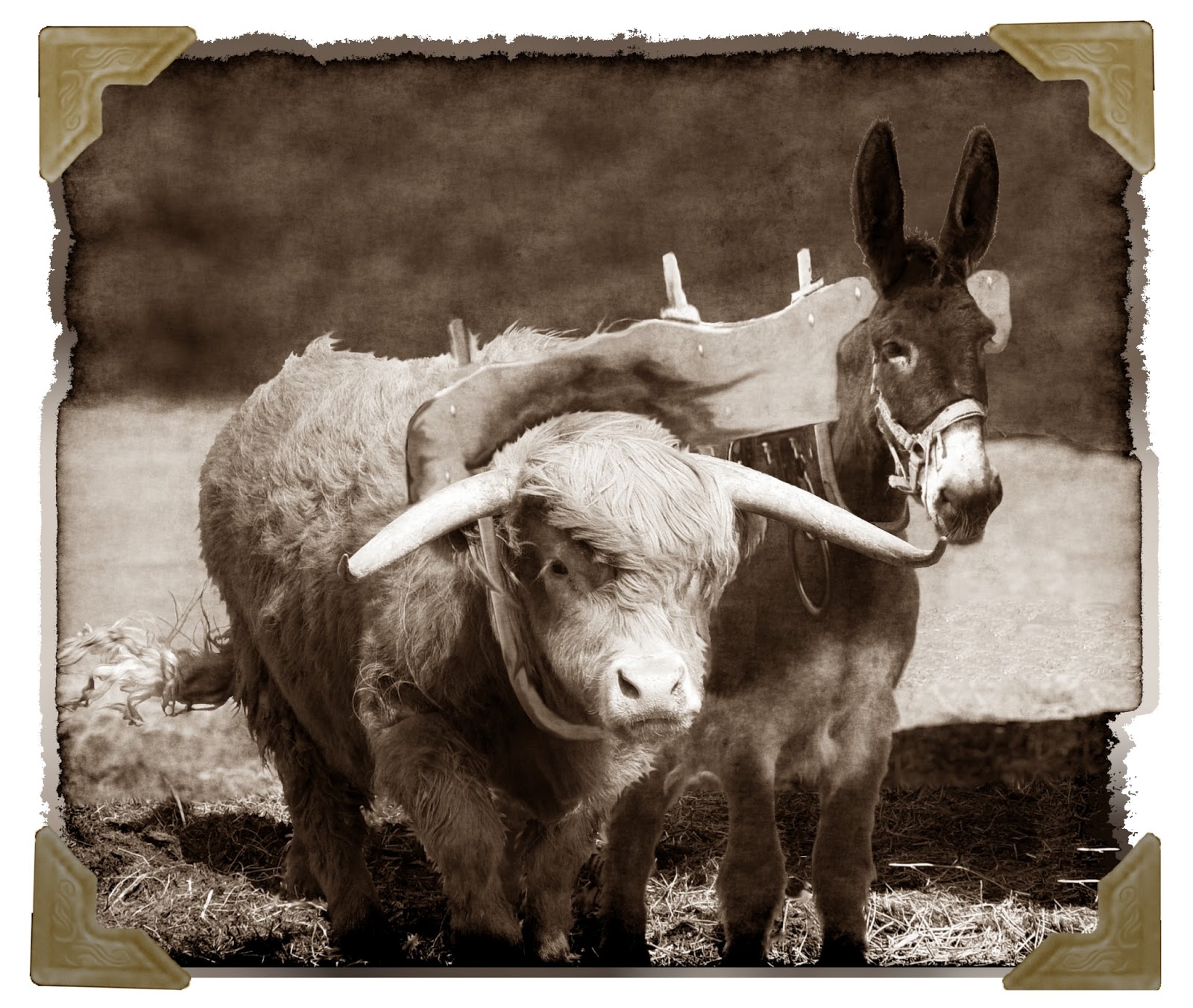
The picture is a bit extreme, nobody in their right mind would tether an ox and a donkey, but we run the risk of ending up in that situation every day. What unsettles one partner slightly may derail the faith of the other completely. The result is a very uneven spread of the burden of marriage.

I’m not going to pretend I can cover all aspects of marriage in one single posting here, so this will probably be one of several over the next few weeks.

Imagine a couple who have been married for several years. One day they hear that one of them has a terminal illness. How do they respond?

The “right” answer is to run to Jesus and live happily ever after.

99.99% of the time that just won’t happen.

In an equal yoke, each spouse takes on a role that supports the other, irrespective of who has the diagnosis itself. But sometimes faith is a fragile thing. Getting the diagnosis may shatter what faith one or other has. How then do we move forward?

What generally happens is that the stronger one shoulders the load while the other regains their footing. That is what partnership is about. It is what marriage is about. But for how long?

Imagine five years later one partner still cannot deal with the situation. What then? By that time the other is being weighed down. And during that time the Enemy has ample opportunity to whisper to the standing partner that they “can’t ask for more help” from outside, not even from close family members because of what they have done already. Perhaps the healthy spouse has had to stop working to care for the sick one. It was imagined to be a temporary situation, but now it’s five years later. Medical bills are piling up and income is dropping. Assets are liquidised – not always voluntarily – to pay for the mounting debt in the hope of a solution.

How do we maintain hope in this?

It’s not easy.

Depression worms its way into the daily life, robbing the sufferer of hope and shattering faith as a result. It could be the sick spouse or the healthy one who becomes despondent. It could be both.

But by the time we admit it’s there, depression has often left us with an unequal yoke. One focussed on the hope of healing and the other on the despair of the loss.

The yoke we carry often becomes unequal as a result of events in our lives. Hopefully it’s only for a short time, but that time can feel like eternity while you’re in the middle of it.

We need to hold on during those times to Hebrews 11:1 and remember that Faith is the result of hope. We need to hold fast to the hope Christ gives us even if our husband or wife loses sight of it. It takes time, but holding to that hope yokes us with Christ and allows Him to carry the load. His burden is easy and we need only focus on Him.

It sounds trite to say it. Almost a cliche in fact, but it’s true nonetheless.

Hold onto hope. It balances the yoke.

Ordinary Life…

The last couple of months have been explosive for Eagle’s Wing Ministries to say the least, and we want to take the opportunity to say thanks to everyone for their interest and contact with the ministry.

That being said, I feel the need to say a few things as part of my testimony within this project…

The vision for EWM came about in 1999 to be a support for the Church, not any specific denomination, providing teaching, testimonies and advice (both solicited and unsolicited) for leaders and church members alike.

The organisation started with Isaiah 40:31 as a prophetic verse to give direction to the vision. We were to “wait on the Lord”. It seemed simple enough at the time, but days turned into weeks turned into months turned into 2011…

That’s where the testimony comes in:

EWM is my passion, but I am a simple man with normal human failings that God gives me strength to overcome. One of these is a strong tendency to procrastinate – hence the delay from 1999 to 2011 – and (though I hate to admit it) the constant feeling that I am not good enough to do what this ministry is called to do. I first felt called to write at the age of 19, some 24 years ago. I didn’t feel I could fill the shoes being offered to me so I ignored the call and did other things, none of which made me feel fulfilled.

I was offered the chance to speak occasionally at my local church – several over the years – and when I spoke unhindered by structure and from my heart I could feel God’s pleasure. Looking back I guess that was where the first inclinations of EWM began.

My heart has always been to encourage the church to truly become disciples themselves, and to make disciples. I felt in recent years that there was a huge gap between what we were called to do by Jesus – make disciples of all nations – and what we ended up doing: making converts. I found people regularly who would tell me they were “saved” twenty years earlier, but they lived very much in an infancy faith, their churches never being equipped to make disciples or never having attended a local church regularly. I’ve heard preachers refer to these as the “saved and stuck” people.

Billy Graham’s crusades for decades have drawn tens of thousands into Christ, but after the crusade moves on many simply fell backwards without the tools to grow. I must stress I in no way am speaking against the crusades campaigns as the church has benefited massively from them. More recently, HTB in London devised the Alpha course, a wonderful tool for leading through to faith and beginning the road to true discipleship. I’ve been privileged to help lead a number of these courses over the years and have seen the churches running them move from strength to strength.

Many of the contacts I’ve received in the last months have been from pastors, church members and representatives of groups of churches wanting to join the church of Eagle’s Wing Ministries.

It’s a huge honour to be in contact with all these people from across the globe and if you’ve not heard from me personally it’s purely because of the amount of correspondence I have to deal with – don’t worry, I promise I will reply personally as soon as I can!

What this whole message and the ministry boils down to is one simple truth: I’m an ordinary guy, no more special than anyone else. People have sent me messages of encouragement for which I am incredibly grateful, but some have said how they wish they could be like me.

I put off writing for many years using the excuse that I wasn’t CS Lewis or John Eldridge or Max Lucado. I kept praying and God kept telling me to write what He gave me and I kept resisting. Eventually I felt Him saying to me “David, I have a CS Lewis, John Eldredge and a Max Lucado writing for me already. I don’t need you to be them – I need you to be YOU!”

It was a revelation. That night in 2011 I began this blog and started to work on the book He inspired me to write. The book is a work in progress as I can only write it part-time, but I try to make time to grow this web page as often as I can.

The Truth is that God has spent thousands of years working through normal, everyday people like you and me to do incredible, extraordinary things.

Don’t settle for a “normal” life. Don’t be “ordinary”.

God wants us to be extraordinary, and if we’ll listen and act then there’s nothing He calls us to that we can’t do.

Hope

I first wrote this in 2011, just after my family had received shattering and life-changing news.

A few weeks ago I wrote about Faith. Today I find my thoughts dwelling on Hope.

According to Paul in 1 Corinthians 13, Hope is one of the three things that is eternal, the other 2 being Faith and Love.

The last month, for reasons I’ll not go into right now, has been one of te hardest of my life. Harder than my brother’s death. Harder than my father’s cancer and death.

The thing that has kept me moving is Hope. It’s fragile. It’s sometimes just out of reach. It gets put off.

We all live in a constant state of hope. We hope we’ll get the promotion, win the lottery, get the girl. These little hopes keep us moving. Then there’s the bigger ones. We hope the test result will be positive, or negative, or neutral. We hope it was a mistake. We hope it wasn’t. (whatever “it” is!)

But these hopes are not exactly what was meant. The “Hope” Paul speaks of is Eternity. But it’s not the only time Hope is referred to in the Bible. Proverbs 13:12 says “Hope deferred makes the heart sick, but a longing fulfilled is a tree of life”. And so often we have to live with a deferred hope.

This 21st Century is filled with deferred hope. It’s the trademark of modern life. Hardly surprising then that there are more people diagnosed as depressed now than at any time in history, and medications to counter the effects of depression are handed out to children like candy.

Now I’m not opposed to antidepressants. I’m not ashamed to say I’ve needed them in the past. I used them for over 2 years to help me get through a deep depression a few years ago, and my friends who got round me and helped me through that time can testify to the state I was in. And to my attitude to these meds before and after I had to take them.

But this isn’t about medication. It’s about Hope.

Hope when I was depressed, was a continually elusive phenomenon. Always just out of reach, and always “tomorrow”. It was soul destroying. I struggled with suicidal thoughts (and a few tries) and self-harming when the emotion was too strong. The hope I had was that the pain would stop.

Christ suffered pain and emotional torment in the Garden before the crucifixion. He sweated blood and cried out to God to let the cup pass from Him. Ultimately He regained His Hope by handing His despair over to His Father. It took me several years to be able to do the same. Jesus’ victory may have been finalised on the Cross, but the greatest battle, arguably, took place in Gethsemane.

And Hope won out.

Jesus’ human nature didn’t want to be crucified. Who would? His human hope was the passing of the cup. His Godly Hope was us. We were the Joy set before Him. Our salvation and restoration of relationship was His Hope.

We must lean on God, accept His Spirit as the Comforter, and look to His Hope for our lives. We must live as though now is the only moment we have, because it is. We are only guaranteed this heartbeat. But Hope for our Eternal Future is what we must hold on to.

Hope is sometimes all we have. Paul and Silas hoped God would move in the Jail Cell. Paul chose to stay in this world when he wanted to go to the next for our benefit, but that too was a hope. At times all the apostles had was the hope of what would come in the next world, and it gave them peace in this.

“Let not your hearts be troubled” is a recurring theme in John 14, 15 and 16. Jesus repeatedly said to the disciples not to be troubled. Then He went out and was crucified. The disciples temporarily lost hope because they missed what He had told them. To avoid anyone else having to go through that John wrote a detailed account of what Jesus taught them that night.

He pointed out how important perspective is. Hope is based on perspective. We cannot be hopeful if our perspective is wrong.

Hope is eternal. It is tied to eternity. But it is easily overthrown in this world. The Enemy is an opportunist, and since Hope leads us into Faith and Love, he seeks to destroy it.

Guard your hearts, for they are the wellspring of life we are told be the writer of Proverbs – possibly Solomon. Hope feeds that spring. God speaks to us through the Heart, and we must guard it. Hope gives us life.

Hope made us ask Jesus in in the first place.

Guard your heart. It’s fragile. But strong when it’s filled with God’s Hope.