Better than “Good”?

I’ve heard some dumb things the last couple of weeks as I’m making my way through the current Wasteland experience. Many that made me cringe.

But the worst is just one word: “Better”.

Read Genesis, specifically the story of Creation. God says as He completes each stage that it was “Good”.

Then He makes Man. And Man invents “Better”, with a little assistance from Satan.

It’s about deception.. Eve was deceived into believing there was something God was witholding from her. That there was something “better” that was contained in the Fruit of the Tree of Knowledge.

It was a lie then, and it’s a lie now.

“Better” is a lie.

God made things a certain way and said it was Good.

What amazes me is the Tree Eve was tricked into eating from was the Knowledge of Good and Evil. Yet somehow that has got confused in the 21st Century.

It began with little things. Language changed. Words’ meaning became inverted. “Wicked”, “Bad”, “Sick” all took on a meaning through slang that was the exact opposite of the original meaning of the words. Other words changed their meanings too, and eventually things slipped through that began to make behaviours God expressly condemned into acceptable parts of behaviour to our “better” society.

A while ago one particular website, Ashley Madison, was the embodiment of this. Life is short, too short not to have an affair, was the “concept” behind the marketing.

And it worked.

Lie built on lie, and ministries were toppled, marriages destroyed, families torn apart. All for the desire for something “better”.

I heard an interview a while later with a man whose marriage had fallen apart after his wife had found out he visited the site – not that he actually had an affair, just that he’d considered it. Another search for “better” instead of working on what is “Good”. The man said he knew he was in trouble when a woman he wrote to wrote back calling him “Tiger”. He explained that it wasn’t the moniker itself that was the issue. It was the effect it had on him because of who had said it. He described how he realised he longed for someone to think of him that way again. He was just “Bob” or “Jim” (I can’t remember his actual name) to his wife. Not “Darling” or “Sweetheart” or any of the pet names they’d had for each other twenty years before when they got married.

So his “good” marriage fell prey to “better”.

Recently a tower block in London burned down, taking 80+ lives with it. Babies, children, parents, the elderly all died. Because a business thought it would be “better” to use a particular cladding on the outside that was slightly cheaper than the fire resistant type.

Sometimes, “better” can be catastrophic.

Yet we don’t learn. Paul writes that the point of the Scriptures is so we don’t have to learn by making mistakes – we can learn from the example of those who came before. It’s the First Century equivalent of “those who fail to learn history are doomed to repeat it”.

Yet we sit watching tyrant after tyrant elected by “intelligent” populations. Policies from both the far Right and Left wing get thrown at us ad nauseam that historically have proved catastrophic for the countries that have adopted them. Fascism, communism and everything in between being touted as the “latest” ideas.

In England, Jeremy Corbyn wants something “better” than the Tory manifesto – so he suggested policies which were shown in the 1970s to be disastrous for the country. But the youth who voted for him en masse weren’t born then, and haven’t studied history to see the mess the country was in as a result. But on the other side is Theresa May, who seems to want to be Margaret Thatcher. And the policies she’s suggesting are no better. Thirty years ago they may have worked, but it’s 2017 now, not 1987.

Most days it feels like it’s 1984.

The news coming through from America is no better. Donald Trump seems to be bent on making sure his maladministration simply undoes everything Barak Obama did during his administration. If someone had presented the last 12 months as a script to a Hollywood executive twenty years ago they would have been thrown out because any script must be able to withstand the concept of “suspension of disbelief”, and it would have been deemed that the current insanity was too deranged to pass that test. The closest we got was “Demolition Man”, when Stallone got to fight Snipes in a post-apocalyptic future ruled by a crazy leader (Nigel Havers) and Schwarzenegger had been President. All things considered, that was less unlikely than what we’ve ended up with.

So as Christians, what can we do to fight this slide towards chaos?

Firstly, we need to return to a basic set of concepts.

Jesus put it best when He was asked what the greatest Commandment was:

Jesus said to him, “‘You shall love the Lord your God with all your heart, with all your soul, and with all your mind.’ This is the first and great commandment. And the second is like it: ‘You shall love your neighbor as yourself.’ On these two commandments hang all the Law and the Prophets.”

Matthew 22:37-40 NKJV

To find the original “Good”, we need to return to the source: God Himself.

As a society, we are devolving at an alarming rate.

I try not to engage too often with atheists online as the results are predictable. If, as a Christian, I challenge them about the issue of Creation the result is universally ridiculed. I get the “so you believe the earth is only 6000 years old” argument – even if I preface my answer with rejecting that notion clearly and unequivocally. If I bring up the example of life itself, using the example of a seed growing into a plant I am always responded to by someone trying to argue nonsense about another clause in my sentence, never the issue of the question itself.

This week I (foolishly, I know) tried to argue a point on the Huffington Post about life. I asked an atheist to explain, if there is no creator, why a scientist can mix the chemical components that make up an acorn into something that on a molecular level looks like an acorn, and to the naked eye looks just like an acorn, yet when placed in soil it simply rots and doesn’t become an oak tree. The response I got was that it was a poor argument for evolution!

I replied that I wasn’t trying to prove or disprove evolution, but that an acorn doesn’t evolve into an oak, it is the seed from which an oak tree grows.

As yet, the atheist has yet to respond.

I’m not surprised. Their own argument defeats them every time.

First we must seek God.

Wholeheartedly. Unflinchingly. Unwavering in our search.

My time in Wasteland – again – is reminding me just how essential it is to do this.

Wasteland is not a waste of time. I think of it as a time of preparation. A time to shake off the dust of the past, to drop everything that is not absolutely vital to our moving forward with God.

It’s not an easy time. And I think how long we spend in the wastes is determined by us. We tend to limit how fast God can work in us by refusing to let go of the past, or daydreaming of a decidedly ungodly future. I’ve been guilty of that in the past, and even a little this time through.

My last major trip in Wasteland cost me 20 years. I’m hoping right now that I learned something from that time I can apply now.
Who Wants This?

I’m moving to a new location in a few weeks and I’m trying to train my replacement to take over from me. I’m still going to be Director of the company, but the day-to-day stuff will be done by the new manager. We have a similar sense of humour – which is a mixed blessing. It means we get on well – vital for business – but sometimes we spend too much time laughing at dumb things I’ve accidentally done instead of me getting on and teaching her the nitty-gritty of managing the practice.

But I think about what I’ve been doing for the last thirteen years a lot. As well as creating this blog for Eagle’s Wing Ministries, my day-job has been managing the medical practice my wife and I own, and for the last 3 years keeping things ticking over at the medical centre for her, a dentist, a physiotherapist and an optometrist. It’s hard work sometimes. People management is the worst. Hiring I can do easily, but three times now I’ve had to fire someone, and only once did I not lose sleep over doing it. We’re a small business and consequently we work closely together and inevitably I tend to care about the people as friends. So if they let me down, it hurts on a personal level beyond the professional.

One receptionist we suspected of theft, but couldn’t prove it. She was popular with the patients and I didn’t want to believe she was a thief. I was right. She wasn’t a thief.

She was an addict.

We gave her two months paid leave to get clean. We’re a dispensing practice, so we carry a lot of stock in terms of medicines like morphine, pethidine, codeine, ephedrine, and a range of tranquilisers, all of which are highly addictive and dangerous in the hands of an addict. She managed to get off the “tik” – a form of crystal meth – she had been hooked on, but when she relapsed we had no choice for her sake or our own but to let her go. I hated that. I had to tell a young mother she no longer had a job because of her addiction.

The other one I was troubled by was a single mum who had been set-up by her ex. We got an anonymous tip that she was an addict, so we carried out a random drug test from our in-house stock. She failed it, showing signs of opiates (heroin) as well as cocaine and marijuana. I couldn’t believe it. Again – as is my protocol – we gave her one month to get clean. During that month we began to get strange calls asking if she still worked there. We got unusual emails showing the inside of the centre with clothing strewn around the waiting area as if someone were sleeping there. The messages claimed she was sleeping in the centre and offered the photos as “proof”.

I was not surprised when, a month later, a test I bought on the way in to work was completely clear of all drugs. My reason? I’d changed the locks. It turned out her ex had been able to access the building. Suspecting this, I’d thrown out our old drug-test kits that morning and replaced them. We were all relieved when not a trace showed up. But timekeeping was a problem. We finally managed to get rid of her ex, but the local public transport is a nightmare. Unreliable rail service and not on a bus or “taxi” route all added up, and chronic lateness ensued. After complaints from the practitioners about it, we had no choice, and I had to fire a friend.

So leadership. Who really wants it?

I get emails every week from groups and individuals inviting me to visit and preach. It’s an honour to be invited, and I keep every invite (at least, the ones I save from my stupid computer’s “junk” box) and reply. If you sent an invitation and didn’t get a reply, please try again by writing directly instead of the “contact” form. (Address at the bottom of this post)

In among the ministry emails this morning was one titled “Why Do You Want To Be A Leader?”

It made me think.

I started my own business in South Africa because it was almost impossible to find a job where I’d be able to do what I’ve spent over 20 years now doing because of the way the labour law is structured. But nobody could stop me being my own boss.

In England – where I’m now moving – I was written off by the system as “permanently disabled due to mental illness” in 1999/2000. This was major depression following my father’s death, the breakup of my engagement and the death of one of my dearest friends. Moving back now, I’ll have to convince the establishment that 17 years later and having completed a degree I’m actually not “disabled”.

Are there things I can’t do in terms of changes in me resulting from that specific time in my life?

Yes.

They are things like:

  • I have no tolerance level for bull. Life’s too short.
  • I won’t tolerate discrimination based on skin colour.
  • I won’t be bullied into taking a job with no real responsibilities – that was what finally triggered my meltdown.
  • I won’t let someone else tell me what I’m not capable of.

It’s a simple list, and mostly things I thought before I needed the break mentally. “Stress” is something different to everyone. Some people thrive in environments that would crush others.

So now I look at where I am, and I think “why do I want to be a leader?”

Then I think “DO I want to be a ‘leader’?”

The simple answer is “no”.

Eagle’s Wing Ministries isn’t about becoming a “leader”, it’s about being a “follower”.

I think if people go into ministry because they want the title, power or perceived respect that they think comes with it then they probably shouldn’t be considered for a leadership role.

I was asked by a church leader who pastored several churches across a large area about a situation that had arisen. There had been civil unrest some years before and one of the young leaders of that time, who had been involved in stirring up hate in the area of Africa they were in had now become a Christian and joined his church. The congregation had struggled. He had been a visible member of a group known to have recruited child soldiersd2ce8-military_helmet_and_cross from some of the families in the church, and now they struggled to get past his past.
It’s very understandable. I thought for some time before I replied. Since the church leader had personally brought this man into the church, it needed to be his choice that resolved the issue. But he was so close to the situation he needed help to find perspective.

My reply was that since he had several churches far away from where the conflict had been, perhaps for a time he should send this man to one of them. This would allow him to work with the congregation to find a place of forgiveness, and work with the young ex-guerilla to grow spiritually. Alternatively, he could leave everyone where they were and try to sort it out together – a much more challenging option, but possibly a faster one.

Last I heard, the ex-guerilla had moved far away from the church where they had feared him, to a place where his past was unknown to the people personally. He was being considered for eldership in that branch of the church group, but was struggling with the invitation to lead because of his own feelings about his past.

I always ask people who write not to call me “Pastor”, or “Prophet”, or “Bishop”. I’m none of those things any more than anyone else. If the writing on this site blesses you, then that’s great – it’s my aim in writing it. If it helps you avoid mistakes I’ve made, fantastic! But I’m still not any of those things any more than you are.

We all are “sinners saved by Grace”. We also all have Spiritual Gifts through the Holy Spirit. And choosing to move in those gifts doesn’t make someone “better” or somehow “more holy” than anyone else.

Nobody has gifts more important than any others. More visible, perhaps, but not important. My grandmother’s brothers were pilots during World War Two. They were very aware that the only reason they got to fly the planes was the small army of mechanics, welders, drivers, and ground staff that kept the planes and airfields in a usable condition. “Pip”, as my uncle was known (Flt Lt Wilfred Rowland Travell DFC, 220 Squadron), told me many stories about his exploits as a pilot, but he always spoke of how much the guys on the ground meant to him. For every plane in the air there were around 75 people on the ground making sure it could be. The pilot got the recognition, but if just one person was missing from the “support” team on the ground, the plane didn’t get off the airstrip.

It’s the same in ministry.bc346-sheep

Not everyone is called to write, or speak, or sing, or lead worship. Some sweep halls. Some erect tents. Some rig lighting or sound. I do what I’m called and gifted to do. Something that stopped me writing for almost 20 years was the thought that I couldn’t write like CS Lewis or Max Lucado or John Eldredge. It wasn’t until recently (when I began this blog on “blogspot.com”) that I realised God already had a Lewis, Lucado and Eldredge. I’m not called to be them. I’m called to let Him make me into the best “David Beddow” I can be.

Nobody else.

Just be “David Beddow”. Be myself.

It’s critical.

So I don’t want to be a leader. But we are all leaders. We all have people that follow us, listen to our words and watch our actions.

So watch your step.

I guarantee someone else is…


If the “contact” form hasn’t got you a reply from me, write directly to me: david@eagleswingministries.org

It’s [Not] Complicated…

Complicated and Confused

The biggest issue I hear when I tell people I’m a Christian is “Isn’t it terribly complicated? I mean, there’s all those things you can’t do.”

The hardest thing about my Faith in my experience is explaining how simple it actually is. Most people seem to think Christianity is either irrelevant – which is ok because they have a clear idea of what they’re rejecting – or similar to the Gordian Knot in it’s complexity.

In point of fact, Christianity is a very simple system. It goes something like this:

  • God is a just God.
  • He gave Adam one “don’t” instruction and told him the consequences of breaking it.
  • Adam broke it.
  • Rather than wipe out all His creation and start over, God chose to take His own punishment on behalf of Adam’s descendants.
  • He gives us the choice to accept His gift or reject it.
  • Acceptance makes us right with Him for eternity
  • Rejection means we face His judgement.

The issue most people today have is trying to deal with the thought that a Loving God will send people to Hell.

Mostly this is avoided by simply not believing in Hell. It makes it easy because people stop seeing consequences to their actions. The death penalty is no longer an effective deterrent to criminals in part because they have no concept of what lies beyond. Consider how in the USA the number of mass shootings end with suicide by the gunman. There’s no fear of an eternal consequence for their actions.

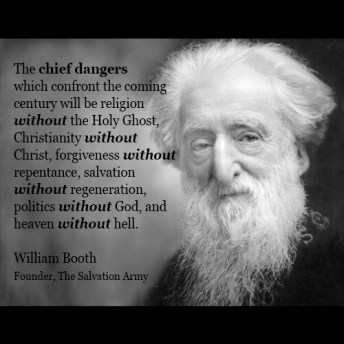
3909d-william2bbooth

William Booth spoke of the

consequences we face today at the turn of the 19th Century.

He was largely dismissed at the time as people couldn’t imagine a world where his predictions could happen.

Within 2 decades the First World War broke out and Western society changed forever. Just 21 years later in 1939 the Second World War took out the second consecutive generation of young men on a global scale and the change was effectively complete. By the late 1950s and early 60s the concept of Hell was all but dropped by most preachers. Many wouldn’t touch it because of the experiences so many had had during the War, either by bombings or on the battlefields of Europe and the Far East. Korea and Vietnam didn’t help, and the concept of “Hell on Earth” became popular and having been through it, Heaven would surely be the reward for everyone.

Now Christianity is straightforward, but not that simple.

Christianity is such a straightforward offer that it requires special talent to misunderstand it. Unfortunately, there is much of this talent available.

God is not the author of confusion (1 Corinthians 14:33). He is undoubtedly a God of order. You can’t look at the way the planets rotate or how perfectly a honey-bee is able to draw the nectar from a flower and truly doubt the perfection of His design. Such design can only be achieved through order.

Yet somehow Christianity has been relegated to a “get out of Hell free” card in some transcendental monopoly game. So often there is little, if any, sign of Power in Faith. I’m not talking about political power, but real life changing power as the Disciples showed.

Over the last 2000 years there have been times of growth and times of stagnation in the Christian Faith. Every time of growth has corresponded with a return by a significant group to the simple, basic Truths of the Faith that have been central since Jesus’s time.

Capitec, a small bank in South Africa, advertises with the tag-line “Simplicity is the Ultimate Sophistication.” It’s true. The theory is sound. The simpler things are, the better they work.

Compare the simplicity of Christianity with the legalism of Islam. Eat anything because it’s what comes out of our mouth that shows us to be clean or unclean. Pray without ceasing, facing any direction you want and don’t worry if you didn’t bathe first – just talk to Me. Don’t rely on your own efforts to be “good enough” to get to Heaven, just rely on Jesus to be good enough and let Him bring you in.

I have several friends who are Muslim. We don’t often discuss religion as with some it has caused offence in the past. These days I lean more to living Christianity around them and let them ask why I’m doing what I do. It’s difficult, but I’ve always struggled with the people I’m closest to in terms of “evangelising”. I’m not a natural evangelist. On the few occasions we have spoken the differences between our faiths is stark. During Ramadan I spoke to one friend about fasting. She asked how fasting differed for Christians from the Muslim fast. I explained that when I fast I fast for a few days at a time. During that time I will eat nothing and drink only water and tea. She asked me what time each day I stopped. I explained that I didn’t. Fasting is total abstinence from food 24 hours a day while I fast.

She nearly fell off her chair. Not being able to eat at sundown was beyond her comprehension. She asked how long I have to fast for, what the “requirements” were. Again, it was obvious that my response was a surprise. I know people who have fasted for three weeks or more in that way, and some who fast just a day or two.

The freedom from a legalistic requirement on how and when to fast or pray is integral to the concept of Relationship in Christianity. If Alexander Graham Bell had been around in First Century Jerusalem, I’m 100% certain Jesus would have likened prayer to a personal call to God from His children – and He was just waiting for it to ring. The Bible was the call to us, kind of like an answerphone message, begging us to call Him back.

My mum tends to phone me around 8:30pm most nights. If I can’t answer for some reason she leaves a message and if its not too late I call her back. But I can call her or vice-versa at any time during the day. Imagine if I could only call or receive a call at a specific time from a phone plugged in to a particular socket. That wouldn’t be relationship, it would be ritual.

Jesus is all about relationship. His purpose was to restore Relationship with the Father by His sacrifice. The breaking of the legalistic requirements of the Law by completing it was the method. The point of the Law was to show mankind that we could not make it to God ourselves, but rather to point to Him as the one we needed to receive salvation. Any religion that then takes us back to following a set of rules instead of the freedom of Grace confuses and complicates our existence.

There are rituals in Christianity. The most obvious is Communion, but while it is important, the point is not transubstantiation of the sacraments, but rather the symbolic being part of Jesus and Him being part of us. The ritual isn’t supposed to replace the relationship, but remind us of the reason – Relationship.

Simple, clear and plain.

It’s really not that complicated.